
Close

Good for the environment – Good for business

Thursday, March 27th, 2025

Presented as part of Technology Transfer Seminars 2025

Dr Roger Robson-Williams, Plant & Food Research Limited

Dr Roger Robson-Williams is a sustainability professional and scientist, with over 25 years’ experience of leadership in food system R&D. He is responsible for leading sustainability at Plant & Food Research Limited and has an advisory role in sustainability at AgResearch. Roger is also a member of the Sustainability Sub-Board of NZTech.

What’s good for nature is good for business.
Sustainability in business isn’t just a “nice to have”—it’s essential. Even if you don’t buy into the moral imperative, there are strong business reasons to take sustainability seriously. And understanding the global macro context can help to give meaning to and encourage our actions.

So, it was fitting that Dr Roger Robson-Williams began a seminar on sustainability by painting a big picture, which he described as “grim”, but with the assurance that there were some positive insights and a call to action to come.

Roger highlighted that modern society’s consumption has surged since the discovery of fossil fuels, improving lives but depleting resources. “We’re running out of stuff on a planet with finite resources. The earth’s capacity to deal with the waste we create is pushed to tipping point.”

Roger introduced planetary boundaries – the key life supporting systems of the planet that allow us to live comfortably. Based on “The Planetary Health Check” – the most comprehensive, science-based global initiative dedicated to measuring and maintaining the Earth system – these boundaries identify nine critical earth systems that support civilization as we know it. The last fifteen years have shown just how far we are pushing these systems – we are in the red for a least six of the systems.

Closer to home, a New Zealand Ministry for the Environment commissioned report showed our contribution to transgressions in five of those boundaries, especially for nitrogen and phosphorus, where we are greatly exceeding our fair share, and for climate change. An Environment Aotearoa report in 2022,which includes samples and measures to find indicators of environmental health, frames people as part of the environment and a key leverage for environmental change. “We’re in a strong position to address this issue, but all indicators back up the boundaries stories – everything is heading in the wrong direction.” One piece of good news Roger showed was that ozone depletion is reversing because of international action.

Between 2007 and 2017 climate change related floods and droughts cost the NZ economy $840m. It is estimated that if we manage to limit global heating to 2 degrees by 2050, we are still looking at a 4% reduction in global GDP. 3.2 degrees could be as much as an 18% reduction. But most sobering of all, risk assessors see these impacts as massively underestimated and, in their estimates, a 3 degree increase by 2070 would halve global GDP and lead to global economic collapse.

Roger’s key message is that it’s cheaper to act on sustainability now. Mitigations that seem costly now will be far less expensive than future damages. He urged us to see sustainability not as marketing or compliance, but as essential for business survival. What’s good for nature is good for business.

So, what can individuals and businesses do? Roger emphasised the need for everyone to feel empowered and capable of making a difference. He outlined the business case for sustainability:

Resource Efficiency: Conduct energy assessments and implement recommendations to achieve significant savings.
Staff Retention: Younger employees value sustainability policies.
Risk Management: Mitigate risks like energy price volatility.

To get started, focus on your most significant negative environmental impacts and understand what you can do about them. Make rational business decisions—avoid greenwashing and prioritize the big issues.

Roger recommended the Future-Fit Business Benchmark, a science-based framework that provides a numeric score to help businesses understand their biggest impacts and quickly act. It helps track progress, plan, and prioritize sustainability efforts, embedding practices like renewables, living wages, and greenhouse gas emissions reduction into business operations. Plant & Food Research Limited and AgResearch have both adopted the Benchmark along with many other businesses in the Asia Pacific region.

Roger also recommended an emerging methodology called Planetary Accounting, which translates the Planetary Boundaries concept into Planetary Facts that can help inform consumers about the true environmental impacts of the products they choose.

It takes courage to transform and go beyond profit, small gestures or the hope that technology will save us, but the cost of inaction is far greater.
BIRT Technology Transfer Seminars 2025 Evaluation

Tuesday, March 25th, 2025

Thank you to everyone who attended the Technology Transfer Seminars in Auckland (in person or online)  and Christchurch.

Evaluation 2025 Technology Transfer Seminars

Please provide feedback on the 2025 Technology Transfer Seminars. Your feedback will guide us when planning future events.

Please select which Seminar you attended(Required)
What did you think of the topics presented at the Seminars?
How would you rate the presentation by Dr Robson-Williams - 'Good for the Environment - Good for Business'?
How would you rate the presentation by Lyn Mayes - 'Update on the Soft Plastic Recycling Scheme'?
How would you rate the presentation by Stacey Fellows - 'Better Energy Management for Bakers'?
How would you rate the presentation by Roger Romsom & Rutger Drost - 'Sustainbility for the Baking Industry - Food without Footprint'?
How would you rate the presentation by Syahmeer How - 'Baking Global Technology Scan'?
How would you rate the presentation by Gert-Jan Moggre - 'Bread Bags from Bread Returns'?
How would you rate the presentation by Jess Broun - 'Leading Action on Food Waste'?
How would you rate the presentation by Jo Drummond - 'Field to Flour: Can we Reduce our Footprint?'
How would you rate the presentation by Stuart Walker (Akl only) - Recovering Valuable Resources to Create Sustainable Biogas and Biofertiliser'?
How would you rate the format of the Seminar?
How would you rate the venue facilities?
How would you rate the food offered at lunch and breaks?
Would you recommend attending the Technology Transfer Seminar to your Work Colleagues?

Two winners named in 2024 Bread Baker of the Year competition

Thursday, November 21st, 2024

Media Release: 21 November 2024

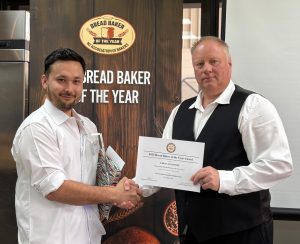
Sadat Ali Rahimi of Coupland’s Christchurch has been named NZ Association of Bakers Bread Baker of the Year. Delmari Janse van Rensburg of New World Rolleston was named second in the competition and was awarded Young Bread Baker of the Year.
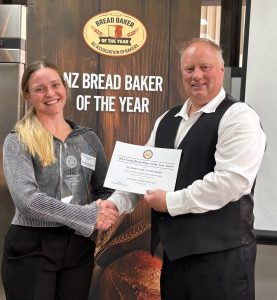
Both winners have won a grant of up to $15,000 to use for research on a bakery related subject. Delmari has also been nominated to represent New Zealand at the LA Judge Award in Australia in May 2025.

Ali has fond memories of his Grandfather’s bakery in Afghanistan and he wonders if that is why when he arrived in New Zealand in 2014 he took a role as a packer at Coupland’s Christchurch. Ali worked his way through the departments at Coupland’s and with hard work and support from the Coupland’s team he made his way to the bread plant. In 2023 he completed his New Zealand Certificate in Trade Baking (Plant Bread) Level 4. Ali enjoys working on all the different steps of the bread manufacturing process and enjoys the challenge of consistently making quality bakery products.

Delmari didn’t set out to be a baker, in fact she started a degree in Marketing but once she discovered baking, her passion for a career in the industry grew. Originally from South Africa, for the last four years, Delmari has worked in the bakery department at New World Rolleston. In July of this year, Delmari completed her New Zealand Certificate in Trade Baking Level 4. Within her role at New World, Delmari is involved in all stages of the baking process and enjoys the personal satisfaction of seeing the products she has created on the shelf.

The Competition is open to nearly or newly qualified bread bakery apprentices. This year is the first time that the competition has offered two classes of entry, a new open class with no age limit and the original Young Baker class where candidates must be no older than 30 years of age on 1 January 2024. Competitors were required to present a speciality bread and describe their product development process and how they would market their product. Entrants also completed a 90-minute theory of baking technology exam and a five-hour practical session.

Judging Co-ordinator Tania Watson says the “new concept of asking contestants to bring their own speciality breads to the competition worked well with some interesting concepts that were made well and tasted good too.”

Judge Grant Inns echoed the thoughts of the Judging Team by saying “the standard of the entrants was very high this year which is truly a credit to the amount of preparation that the contestants have completed.”

Judge Joe Jarkiewicz said, “he was pleased to see representation across all sectors of bakery industry – in store, craft and plant bakeries.” This has allowed contestants to share with their competitors the different processes they engage in within their bakeries.

Judge Nathan Roberts, a past competitor himself, was also impressed by the high standards this year and said, “that the addition of the open class to the Bread Baker of the Year Competition was a positive new dynamic.”

The Bread Baker of the Year Competition is sponsored by the New Zealand Association of Bakers and is designed to promote excellence in people emerging from their training.

ENDS ///
Follow us on Facebook: Young Bread Baker of the Year
For more information, please contact
Tania Watson – Judging Coordinator
New Zealand Association of Bakers
E: tania@bakingresearch.org.nz
M: 021 1659949

Dunedin baker claims 2023 Best Young Bread Baker Award

Thursday, November 16th, 2023

Media Release: 16 November 2023

A Dunedin plant bread baker has taken out the 2023 Young Bread Baker of the Year Award. Tyrone Harvey of Quality Bakers Dunedin receives a research grant of up to $15,000 from the New Zealand Association of Bakers.

Tyrone competed over two days carrying out demanding theoretical and practical testing. While he was surprised by his win, he says he received a lot of encouragement from colleagues to enter. “Putting in the effort to prepare was worth it. I’m not sure what response I’ll get when I arrive back to work. Maybe they’ll get me to shout a BBQ.” Being reserved and preferring to be out of the limelight, Tyrone says the most challenging part of the competition for him was talking to the judges about the product he made.

Judges Joe Jarkiewicz, Grant Inns, Nathan Roberts, and Tania Watson said Tyrone was the clear winner who stood out from the rest because he did well in all facets of the competition. Judging Co-ordinator Tania Watson says Tyrone stepped out of his comfort zone to participate, was a good team player, and was conscious of health and safety in the bakery. “He was first to finish, he was organised, and he helped clean up too,” says Tania.

Tyrone has been baking since 2013. After five years at Countdown in Auckland and a short stint at New World, he joined Quality Bakers Auckland in 2019, then moved to Quality Bakers in Dunedin two months ago, where he is Chief Baker. He completed his Level 4 Plant Baking qualification this year. His focus at work is on producing small goods but he says what he really enjoys is the science behind baking, as knowing how everything works makes it easy to solve problems if they arise.

The competition requires entrants to demonstrate their ability in three areas: a presentation on a given research topic, a 90-minute exam which tests their theoretical knowledge of baking technology, and a five-hour practical session in which they bake a variety of bread-based products.

Judging Co-ordinator Tania Watson says the aim of the competition is to find bakers with potential whose talents can be nurtured through mentoring and development opportunities. “It’s always good to have both plant and craft bakeries represented as they bring different strengths to the competition. We were pleased to have bakers from diverse backgrounds and both the North and South Islands.”

Judge Grant Inns says he wanted to make sure each entrant walked away from the competition feeling confident and proud. Learning and growing is a big part of it,” he said.
Judge Joe Jarkiewicz says he is always keen to see young people compete because of the extra knowledge they gain.

Judge Nathan Roberts, a past competitor himself, says the competition is a huge stepping stone and an opportunity for young bakers to progress their career. “You learn things at the competition that you wouldn’t learn in your everyday job.”

The Young Bread Baker of the Year Competition is sponsored by the New Zealand Association of Bakers and is designed to promote excellence in people emerging from their training.

Follow us on Facebook: Young Bread Baker of the Year
For more information, please contact
Tania Watson – Judging Coordinator
New Zealand Association of Bakers
E: tania@bakingresearch.org.nz
M: 021 1659949

2023 Young Bread Baker of the Year Entrants

Wednesday, November 15th, 2023

Our Young Bread Baker of the Year Competition has kicked off in Auckland this morning with presentations from each of the entrants. We wish them all the best!

Find our more about the entrants in the 2023 Young Bread Baker of the Year Competition. – www.bakeinfo.co.nz/education/apprentice-zone/young-bread-baker-of-the-year/the-2023-entrants/

Follow all the news from the Young Baker of the Year Competition on our Facebook page.

Baker’s Fresh Yeast Handling and Use

Thursday, October 26th, 2023

Presented as part of Technology Transfer Seminars 2023

Bakers are well aware that yeast is a crucial ingredient in baking, playing a key role in fermentation, dough rising, and flavour development. Grant Inns and Dr Hari Saripalli of Mauri presented on another aspect of yeast – the care and attention required in the handling of this important living ingredient, specifically baker’s fresh yeast, of which there are more than 1500 different strains available.

Grant and Hari explained the science behind yeast and the two critical components of yeast gassing – gas production and gas retention. An overview of commercial yeast production outlined the processes involved in getting yeast from the laboratory to the bakery, and the factors which must be controlled during production of liquid cream yeast, stabilised liquid yeast, and compressed yeast.

The emphasis of the presentation was on the handling of fresh yeast, by which they mean best practices for working with yeast, keeping yeast pure, preventing contamination, keeping yeast healthy and reducing yeast stress. As yeast works best within a specific temperature range, they highlighted temperature control as crucial when working with baker’s yeast as it can significantly impact the yeast’s activity and therefore the outcome of baked goods.

Temperature control in the bakery is allows enzymes in the yeast to work efficiently at the optimal temperature, and gas production to occur at a consistent rate.

The advantages of liquid yeast were also made clear, including minimal handling required, excellent dispersion in the dough mass in all types of mixers, good tolerance for low and high water temperatures, and consistent gassing activity. There is also the benefit of bulk storage and no packaging waste.

However proper storage of bakers’ yeast is crucial for maintaining its viability – temperature control at every stage, dark storage, a consistent environment, refrigeration, hygiene, labelling, stock rotation and monitoring for use-by dates.

Grant concluded by encouraging bakers to embrace and commit to good yeast handling and use as it plays such a vital part in creating quality products.

Mandatory fortification of bread making flour

Thursday, October 26th, 2023

Presented as part of Technology Transfer Seminars 2023

Krishna Samy’s presentation on behalf of the New Zealand Flour Millers Association provided an informative summary of the lead up to and implementation of the food standard requiring flour millers in New Zealand to add folic acid to all bread making flour supplied to the baking industry.

The standard was gazetted and mandated in 2021 after many years of discussion about the safety and effectiveness of adding folic acid to flour, as well concern about the practical aspects of implementing the standard. There is now very good evidence that fortification is an effective way to reduce the rate of neural tube defects in pregnancies, and scientific evidence that adding folic acid to bread is safe.

The standard outlines that non-organic wheat flour that is sold as suitable for making bread must contain no less than 2mg/kg and no more than 3mg/kg of folic acid. The specific nature of the measurements was a particular challenge for flour millers as the amounts are so small that the folic acid has to be added to flour first to make a folic acid flour premix which is then added at 1.0 -1.2 % , approx. 250 –300 g/ 1000 kg flour.

Organic bread, bread or flour made from other grains, and wheat flour not specifically intended for bread making (such as for biscuits, cakes, pastry, and pizzas) does not need to be fortified. This provides a choice for consumers who don’t want to consume folic acid.

A two-year transition period for the implementation of the standard began in August 2021. It was a complex process for all involved.

Krishna emphasised the importance of ongoing collaboration between MPI, the flour millers and the baking industry in meeting the deadline, despite covid related shipping issues and standard equipment from Europe not meeting NZ electrical standards. It was a close call for some mills he says, but all equipment was installed and micro-dosers validated by 14 August 2023.

Meanwhile in the baking industry, bakers had to change hundreds of product labels, a process that also took place during the two-year transition period. To ensure the labels matched the content, until fortified flour became available, some bakeries had to add folic acid premix manually as fortified packaging came on line.

New Zealand Food Safety is working with flour millers to ensure they are fortifying at the right levels, and flour is surveyed periodically to check levels. Mass balancing, analytical testing, records, procedures and maintenance have all been put in place, with ongoing monitoring and testing, and Krishna says it is now business as usual for all flour mills and bakeries.

Energy Transfer in CBP/MDD Mixing Equipment – Managing Dough Development

Thursday, October 26th, 2023

Presented as part of Technology Transfer Seminars 2023

Stan followed up his thought-provoking first presentation with a second talk about the controversial subject of energy transfer during dough mixing. The key in all cases, he said, is understanding the concept as well as the consequences of energy transfer during mixing.

90% of final bread quality is determined by what the baker chooses to do in the mixer. Dough development can’t be undone. After the dough has left the mixer, there is almost nothing the baker can do to compensate with changes in dough processing for errors in the mix, so getting it right first time is crucial.

Stan revised what goes on during mixing, starting with the dispersion and uniform blending of ingredients, and going on to cover the hydration of flour protein to form gluten, hydration of damaged starch, delivery of energy as part of dough development, incorporation of air and initiation of oxidation, creation of gas bubble structures, and the final dough temperature being higher than the sum of the ingredient temperatures, the control of which has serious implications in practical terms.

Stan shared his “house of bread quality” concept, in which the strength begins with the foundation of the development of the gluten network through the transfer of energy – work input – and the control of final dough temperature. The “walls”, he said, are the ascorbic acid-assisted oxidation of the gluten network coming from the gas that is incorporated in large quantities through mixing, and oxygen, the presence of which is an important part of the AA oxidation. The “roof” is made up of improvers that are usually expensive so there is a need to use as little as possible. Inside the “house” are the gas bubbles created during the mixing process which will grow and develop.

The whole of the baking process, Stan emphasised, is about creating a set of conditions which we don’t know quite know the outcome of until the dough goes into the oven and comes out again. He stressed the need for bakers to be consistent in the bakery too, rather than just asking flour millers to provide consistent flour.

He discussed in detail mechanical dough development, work input versus mixing time, the impact of mixing speed on crumb structure, the role of energy in dough development, the two approaches dough temperature of choosing and controlling, and then went on to elaborate on the principles and practice of controlling dough temperature. Further topics were the effect of ingredients on dough rheology, gas volume incorporated during mixing, the contribution of pressure control, cell creation and crumb structure control, and controlling oxidation and structure.

Stan’s final topic was one that could be particularly useful to bakers – how understanding mixing curves helps understand dough development and working out exactly what is happening in the mixer. He looped back to his previous presentation to emphasise that the analytical data are not wrong. The problem is that the right things are not being measured to allow prediction of baking quality.

He concluded by reiterating that it is not just about controlling energy, it is about understanding a whole series of complicated relationships occurring during the dough mixing process, all of which contribute to final bread quality.

Value Added Wheat – Genomic Prediction Modelling

Thursday, October 26th, 2023

Presented as part of Technology Transfer Seminars 2023

Following on from Sarah Robert’s presentation on reducing gluten allergenicity, Paul Johnston presented the results of research exploring another option for addressing the gluten-related disorders – developing a low allergenicity wheat.

Gluten-related disorders are a worldwide problem in the form of coeliac disease, wheat allergies and non-coeliac wheat sensitivity. As approximately 20% of worldwide calories comes from wheat and gluten is also found in a multitude of foods, the issue is significant. Solutions involve gluten avoidance (studies show that up to 30% of people actively avoid gluten), longer fermentation, gliadin extraction technologies, and wheat varieties with reduced allergenicity – the focus of this research.

Gluten epitopes are specific amino acid sequences, often high in Proline (P) and Glutamine (Q), making them resistant to intestinal degradation. An immune response to these gluten epitopes can be triggered in genetically susceptible consumers. Gluten epitopes exist within the larger gluten complex but only make up a small portion of the total gluten protein.

In breeding for a low gluten epitope, there is a need for variation in epitope concentration, which requires a wide sample of milling and feed wheats from NZ, Canada, Australia and the UK. Understanding the role of genetics versus environmental factors versus management is also essential, as is understanding the connections between epitope concentrations and other important traits such as grain protein and baking quality.

Paul emphasised baking quality and the importance of flour needing to be fit for purpose. Breeding is complex ten-year process he says, and while it is possible to shortcut the process there is never going to be one line of wheat that does everything.

Findings over the last three years in which the project has been running are that low epitope wheat won’t help those who are already suffering from coeliac disease, but there is potential way to reduce the frequency of inflammatory issues in consumers.

As results indicate that it is possible to breed for lower gluten epitope, the next steps are to identify how best to implement this knowledge into the PFR wheat breeding program and produce fit for purpose wheat cultivars with reduced gluten epitope.

Reduction of Gluten Allergenicity

Thursday, October 26th, 2023

Presented as part of Technology Transfer Seminars 2023

As the third most produced cereal in the world, wheat is used in many products and vital gluten is increasingly being added to a wide range of products because of the valuable rheological properties it can add to products without adding much to cost. This has resulted in there being an increased dietary intake of total wheat gluten over the decades, often without consumers realising it.

With up to 30% of the population having the potential to develop Coeliac disease (CD), and 15-20% of people diagnosed, it potentially leaves 80% of the population exposed to risk and complications of the disease. For other consumers non-coeliac gluten sensitivity (NCGS) is an issue. Up to 15% of the population have self-reported problems with consuming gluten products, including bread. It is now also a well-known marketing strategy to target consumers looking to avoid/reduce gluten intake.

So how can we counteract the negative association of eating wheat and improve overall digestibility and comfort from eating wheat-based foods? Reducing the levels of coeliac epitopes in foods made from New Zealand wheats is one strategy being investigated by Sarah Roberts and team. They are exploring the reductions that are possible through breeding, agronomy, milling, and processing techniques prior to baking.

Plant & Food NZ “Wheats for wellness” programme is developing new cultivars and processing strategies to reduce the impact of coeliac peptides. New wheats breeds have been bred with lower levels of epitopes while maintaining wheat quality. Initial milling discoveries show that combining selected flour streams could possibly produce useable quantities of flour with epitope concentrations reduced by up to 25%. The ingestion of lower levels of gluten/epitopes may have delaying effects on susceptibility of developing CD or NCGS. Severity of the symptoms may also be reduced.

Sarah presented on a series of BIRT funded research projects looking into whether different technologies could be brought together to improve consumer tolerance (improved digestibility and comfort) to gluten found in wheat-based products. This could have profound consequences for disease incidence, pathogenesis and overall consumer health.

Results from these projects so far have shown that:

Conventional wheat breeding can be used to breed wheat cultivars with lower levels of immunogenic peptides, whilst still providing commercially feasible agronomic and baking qualities.

Milling technologies could be applied to reduced epitope levels in flours used industrially.
Sourdough starter lactobacillus strains can be isolated from sourdough starters which have the capabilities to hydrolyse gluten.

Longer fermentation times (>24 hours) are required to completely degrade gluten. A 40-60% reduction in gluten has positive effects on cytokine (inflammation) production.

Dough mixing conditions, baking temperatures and baking times have no effect on the digestibility of gluten proteins in breads although large changes in gluten aggregation and gluten macropolymer structure are seen.
The addition of yeast and increased fermentation times degrade fructan levels considerably, increasing digest comfort.

Using a combinational approach could ultimately lead to significant reductions in coeliac epitopes and FODMAPS in food products made from NZ wheats.