
Close

Author Archive

Baking Global Technology Scan

Saturday, March 29th, 2025

Presented as part of Technology Transfer Seminars 2025

Syahmeer How, Plant & Food Research Limited, Research Scientist

Syahmeer How (B.E, PhD Chemical & Bioprocess Engineering, Massey University) is a Bioprocess Engineer at Plant & Food Research Limited in Palmerston North. He specialises in technoeconomic analysis, process optimisation, and decarbonisation strategies for the food industry. Syahmeer plays a key role in developing the Baking Global Technology Scan, applying his expertise in chemical engineering to inform strategic decision-making. Outside of work, he is a passionate squash player and a dedicated foodie.

How can commercial bakeries be more energy efficient and lower their carbon emissions?

EECA (Energy Efficiency and Conservation Authority) aims to mobilise New Zealanders to be world leaders in clean and clever energy use. EECA’s sector decarbonisation programme provides tailored tools and resources to help commercial bakeries be more energy efficient and lower their carbon emissions.

Baking decarbonisation technologies are prominent in Europe and the US. EECA engaged Plant & Food Research Limited to undertake this technology scan looking at emerging technologies and innovation within the baking sector both locally and globally and defining how these could be applied within the New Zealand context.

An energy breakdown showed that baking is the processing step with the largest potential for greenhouse gas (GHG) emission reduction. Scanning the baking process gave an understanding of the energy consumption at each stage of the processes, to see what is most energy intensive for different bakery products. Gas-fired ovens are the main emitter of greenhouse gasses in New Zealand bakeries, and energy loss is a large part of the consumption.

Each technology option was given a rank score from 2–50 based on energy savings/greenhouse gas (GHG) emissions against relative cost of investment. These scores were used to rate and compare the technology options. The technologies were also evaluated for future potential, with ratings projected for 2030 to provide a dynamic outlook. The year 2030 was chosen as a reference point, aligning with New Zealand’s target to reduce greenhouse gas (GHG) emissions by 50% from 2005 levels.

The top technologies and practices recommended from the findings of this report include:

Process Technology

High Temperature Heat Pumps to recover and reuse low temperature heat: A robust decarbonisation solution by utilising waste heat from the production process.

Heat Recovery from Exhaust Gas: This technology provides higher greenhouse gas (GHG) savings compared to insulation upgrades, while remaining low-cost with a high Technology Readiness Level (TRL).

Heat Recovery

Dual Fuel Burners: This flexible option utilises natural gas now, with the capability to switch to electricity in the future.

Hydrogen Burners for Ovens: Future potential exists as infrastructure develops. Currently associated with high operational costs due to limited hydrogen production.

Fuel Switching

Oven Insulation Upgrades: An affordable and easy to implement solution but with minimal impact on greenhouse gas (GHG) emissions.

Exhaust fans with variable dampers: By optimising exhaust systems with variable dampers and adjusting fan drives, bakeries can reduce energy consumption and improve oven efficiency.

Process Scanning & Optimisation: A low-cost, high Technology Readiness Level (TRL) option, although it offers limited greenhouse gas (GHG) emission savings.


Sustainability for the Baking Industry – Food without Footprint

Saturday, March 29th, 2025

Roger Romsom and Rutger Drost, Royal Kaak

Roger Romsom has dedicated nearly 40 years to the food processing industry, with 27 of those years focused on bakery production lines at Royal Kaak. As the head of market development for the Asia and Oceania regions, he is constantly seeking innovative solutions to enhance bakery processes. With a background in mechanical engineering and extensive hands-on experience, his approach combines technical expertise with practical insight to drive efficiency and innovation.
Rutger Drost has 15 years of experience in the B2B food and pharmaceuticals industries, after starting his career as strategy consultant. He joined Royal Kaak 2 years ago and is responsible for global business development, with a strong focus on sustainability. Rutger has led the development of Royal Kaak’s energy and sustainability solutions for bakeries, and he works on partnerships with other machinery suppliers to the baking industry to expand Royal Kaak’s Silo-to-Truck proposition. Rutger has a background in business administration and focuses on turning business strategies into practical solutions.

Helping Bakeries Prepare for the Future

Sustainability is woven into Royal Kaak’s DNA, driving innovation in product development. They have ambitious goals to supply integrated production lines with no ecological footprint, aiming for CO2-neutral lines, production processes, and supply chains.

Roger emphasized the urgency of starting now, not waiting 20 years to change our mentality. New designs today will prepare us for the future.

The focus on energy efficiency and consumption across the industry is driven by climate change, increasing government regulations, limited fossil fuel supplies, and geopolitical tensions affecting energy supply and prices—challenges that hit bakeries hard. Kaak is exploring ways to make a difference and reduce costs and CO2 emissions specifically in bakeries.

Energy use accounts for a considerable part of a bakery’s footprint, with ovens taking 80% of that. Most bakeries rely on natural gas, and while there’s a willingness to electrify, it’s a significant investment. High electricity costs and grid congestion are other barriers that hold back bakeries. Will power be available as more people electrify, and how long will bakeries wait for a grid connection?

To reduce energy consumption and emissions while remaining competitive, Roger and Rutger suggest starting with simple energy savings: turn off equipment not in use, switch off fully rather than leaving on standby, optimize line capacity, reduce compressed air pressure, and set up automatic switching off of conveyor belts.

Such low hanging fruit energy savings can be identified by carefully analysing actual energy consumption. Kaak can scan equipment and conduct onsite assessments to identify energy savings opportunities with the oven, and across the entire line.

Long-term solutions are more structural, including options for electric and hybrid ovens, renewable energy generation (e.g., solar heat), and heat storage.

The green bakery of the future might feature a hybrid oven, renewable energy, a thermal buffer (heat battery storing heat, not electricity), and heat as a service (allowing ovens to run on the most economical energy source). Not relying on a single energy source is key.

When considering new equipment, it’s not just about the initial cost but also emissions and energy consumption. Consider current and future running costs as scenarios change.

Food waste and bread returns are also critical issues. Public awareness means bakeries will feel pressure to address these. Rutger and Roger outlined two potential solutions focused on production control: bake less, supplying 80% fresh and 20% frozen (with consistent quality), or deliver par-baked bread to be finished in supermarkets (again, maintaining high quality).

The path to a greener future requires changes in human behaviour to reduce food waste, the use of sustainable ingredients, and embracing sustainability in bakeries. Manufacturers like Royal Kaak and bakeries can work together to resolve issues, find opportunities and prepare for the future now.


Better energy management for bakers

Friday, March 28th, 2025

Presented as part of Technology Transfer Seminars 2025

Stacey Fellows, Energy Efficiency & Conservation Authority (EECA)

Stacey Fellows is an energy efficiency and sustainability engineer with 20 years’ experience in the dairy manufacturing industry of Aotearoa. Stacey is a firm believer in energy efficiency first, which along with economic and environmental benefits, can reduce the need for energy infrastructure. Stacey is the manager of the Market Partnerships team at EECA (Energy Efficiency Conservation Authority), which includes the sector programme, and enjoys collaborating to action energy and carbon emission savings. Her son Henry is a passionate baker.

Energy efficiency makes sense – use this first says Stacey, then look at renewable energy to save money and the environment. So, what is energy efficiency? Energy efficiency means using less energy to make the same products and services. Energy efficiency is called the “first fuel” in clean energy transitions, as it provides some of the quickest and most cost-effective CO2mitigation options while lowering energy bills and strengthening energy security.

It is entirely possible to achieve good reductions in energy use over time, but you first need to see where your energy goes and to do this you have to think about the whole system, as well as your maintenance routine, not just equipment.

EECA supports bakeries to reduce energy related emissions with tailored tools and resources in collaboration with the industry. This aims to simplify the process of reducing individual business emissions through a guided pathway and support. The pathway connects New Zealand businesses with world-class innovation and best-practice guidance. The focus is on empowering energy users to control their energy use.

The benefits are clear: reduced costs, increased productivity, decreasing your business’s impact on the environment and driving customer interest. There is also the opportunity to future proof your business through collaborative, proactive solutions that can reduce competition for the same services, resources, and opportunities.

Stacey outlined the Five Step Energy Management Pathway for decarbonisation. It includes tailored resources for New Zealand commercial bakeries, enabling them to improve their energy efficiency, save costs, and reduce carbon emissions based on informed decision-making.

Engaging your staff to get excited about energy efficiency is the first step. They need to be part of your bakery’s decarbonisation journey. Measuring and accounting for your energy use is next, then set targets and track your performance. Optimising equipment and improving processes can generate big wins. EECA has a checklist you can use. Reduce your energy demand through new technology or upgrades to processes and carry out an energy scan.

Finally, if you’re thinking of switching to renewable energy, the final step, it’s important to reduce your demand first and then take a holistic approach to the energy mix that is most appropriate. Ensure you make informed decisions about fuel switching by doing the first four steps.

You can visit the EECA website for more information or email Sectordecarb@eeca.govt.nz with your questions.

Update on the Soft Plastic Recycling Scheme

Friday, March 28th, 2025

Presented as part of Technology Transfer Seminars 2025

Lyn Mayes, The Packaging Forum

Lyn Mayes established Mad World in 2001, to build networks and collaboration between the private sector, NGOs and local and central government to improve New Zealand’s environmental performance. She set up the Soft Plastic Recycling Scheme in 2015 for The Packaging Forum and is also sustainability advisor to the Food & Grocery Council. She is an external appointee to the Board of the Association of Metal Recyclers, a Board member of Be a Tidy Kiwi and immediate Past Chair of the Government appointed Auckland Conservation Board. Lyn was awarded a Kings Service Medal for services to conservation in the 2025 New Years Honours.

Innovation and diversification key to soft plastic recycling

We are approaching a decade of soft plastic recycling in New Zealand and bread bags make up 8% of what is collected from consumers. The bakery industry is playing a part in making it happen here, says Lyn, which is good news. But is our soft plastic recycling scheme sustainable? And what can we do to future proof it?

Soft plastic (plastic you can scrunch up into a ball) has no inherent value, so the scheme has to pay the cost of recycling and incentivise businesses to take on the risk of recycling soft plastics to make new products. A few figures to put it into context: In 2024, 737 tonnes of soft plastic was repurposed into posts. 87% of the population has access to soft plastic recycling.

Lyn emphasised the need to increase processing capacity – the scheme only collects what can be repurposed. They do not store it or export it. “We have to create demand. If people aren’t buying the products made from what we collect, the scheme will stop.” Innovation and diversification are key. Research into new and emerging technologies is needed to broaden the range of reprocessing options.

Convenience also needs to increase – kerbside recycling is not available at the moment but a trial underway in Nelson is proving that this would work through its incredible results – 3.48 tonnes after ten collection rounds (20 weeks) from only one thousand households! Change can also be driven by introducing mandatory producer responsibility for plastic packaging. By moving costs onto producers and with industry managing it, not councils, change may happen faster, but a mindset change is needed here first.


Good for the environment – Good for business

Thursday, March 27th, 2025

Presented as part of Technology Transfer Seminars 2025

Dr Roger Robson-Williams, Plant & Food Research Limited

Dr Roger Robson-Williams is a sustainability professional and scientist, with over 25 years’ experience of leadership in food system R&D. He is responsible for leading sustainability at Plant & Food Research Limited and has an advisory role in sustainability at AgResearch. Roger is also a member of the Sustainability Sub-Board of NZTech.

What’s good for nature is good for business.
Sustainability in business isn’t just a “nice to have”—it’s essential. Even if you don’t buy into the moral imperative, there are strong business reasons to take sustainability seriously. And understanding the global macro context can help to give meaning to and encourage our actions.

So, it was fitting that Dr Roger Robson-Williams began a seminar on sustainability by painting a big picture, which he described as “grim”, but with the assurance that there were some positive insights and a call to action to come.

Roger highlighted that modern society’s consumption has surged since the discovery of fossil fuels, improving lives but depleting resources. “We’re running out of stuff on a planet with finite resources. The earth’s capacity to deal with the waste we create is pushed to tipping point.”

Roger introduced planetary boundaries – the key life supporting systems of the planet that allow us to live comfortably. Based on “The Planetary Health Check” – the most comprehensive, science-based global initiative dedicated to measuring and maintaining the Earth system – these boundaries identify nine critical earth systems that support civilization as we know it. The last fifteen years have shown just how far we are pushing these systems – we are in the red for a least six of the systems.

Closer to home, a New Zealand Ministry for the Environment commissioned report showed our contribution to transgressions in five of those boundaries, especially for nitrogen and phosphorus, where we are greatly exceeding our fair share, and for climate change. An Environment Aotearoa report in 2022,which includes samples and measures to find indicators of environmental health, frames people as part of the environment and a key leverage for environmental change. “We’re in a strong position to address this issue, but all indicators back up the boundaries stories – everything is heading in the wrong direction.” One piece of good news Roger showed was that ozone depletion is reversing because of international action.

Between 2007 and 2017 climate change related floods and droughts cost the NZ economy $840m. It is estimated that if we manage to limit global heating to 2 degrees by 2050, we are still looking at a 4% reduction in global GDP. 3.2 degrees could be as much as an 18% reduction. But most sobering of all, risk assessors see these impacts as massively underestimated and, in their estimates, a 3 degree increase by 2070 would halve global GDP and lead to global economic collapse.

Roger’s key message is that it’s cheaper to act on sustainability now. Mitigations that seem costly now will be far less expensive than future damages. He urged us to see sustainability not as marketing or compliance, but as essential for business survival. What’s good for nature is good for business.

So, what can individuals and businesses do? Roger emphasised the need for everyone to feel empowered and capable of making a difference. He outlined the business case for sustainability:

Resource Efficiency: Conduct energy assessments and implement recommendations to achieve significant savings.
Staff Retention: Younger employees value sustainability policies.
Risk Management: Mitigate risks like energy price volatility.

To get started, focus on your most significant negative environmental impacts and understand what you can do about them. Make rational business decisions—avoid greenwashing and prioritize the big issues.

Roger recommended the Future-Fit Business Benchmark, a science-based framework that provides a numeric score to help businesses understand their biggest impacts and quickly act. It helps track progress, plan, and prioritize sustainability efforts, embedding practices like renewables, living wages, and greenhouse gas emissions reduction into business operations. Plant & Food Research Limited and AgResearch have both adopted the Benchmark along with many other businesses in the Asia Pacific region.

Roger also recommended an emerging methodology called Planetary Accounting, which translates the Planetary Boundaries concept into Planetary Facts that can help inform consumers about the true environmental impacts of the products they choose.

It takes courage to transform and go beyond profit, small gestures or the hope that technology will save us, but the cost of inaction is far greater.

NZIFST Annual Conference 2026

Tuesday, March 18th, 2025

Theme for 2026 Conference – Growth

The conference includes events such as:

NZIFST FOOD INDUSTRY AWARDS DINNER
Exhibitor NETWORKING
STUDENT POSTER Competition
3-Minute PITCH Competition
EARLY CAREER FOODIES’ Function

Visit the NZIFST website for more information and to purchase tickets. 


What does it take to get to the L.A Judge Award?

Tuesday, March 18th, 2025

Young Bread Baker of the Year 2024 winner Delmari Janse van Rensburg has been training hard and is on track to compete in the upcoming L.A Judge competition, described as a potentially life-changing experience for young bakers. Delmari has been spending her time working on theoretical and practical preparation with the help of experienced bakers.

Ralph Thorogood provided Delmari modules to assist with her theory work. Nathan Roberts and Jo Jarkiewicz spent a day helping Delmari with maths and its application in scaling up, product plans and throughput calculations. A visit to Quality Bakers gave Delmari insight into and familiarity with plant bread bakery machinery, and she is looking forward to visiting Champion Flour Mill in Christchurch as well as Breadcraft near Wellington with Ralph Thorogood.

Bruno Falco from Bakels and Dave Bradley from Ara have been working with Delmari to perfect her bread plaiting skills, with a focus on designing and executing an excellent finished product.

Foodstuffs have also been supportive in terms of sending Delmari on training trips with external companies. Delmari says her manager Janine Bell has been really helpful, supporting her to practice after work hours. Foodstuffs opened their training facility and Todd Johnson spent time with Delmari on practical training. Foodstuffs have also paid for the time Delmari spent at the Young Bread Baker of the Year Competition and will support her by accessing the training fund when she competes in Australia.

Delmari says she is extremely grateful for the effort and time people are putting into supporting her with the build up to the Competition. We wish her all the best as she represents New Zealand in the LA Judge Competition.

Food Waste Action Week

Sunday, March 16th, 2025

It’s Food Waste Action Week (March 17–23rd March), and the team at Kai Commitment, the voluntary agreement driving action on food waste in New Zealand, have developed a new tool to help businesses get started on reducing food waste – Food Waste Rapid

This practical guide supports businesses at any stage of their food waste action journey – whether you’re just starting out or have a plan in place but are keen to align with the latest best practices.

The tool offers actionable steps to:
Identify areas where food waste occurs within your operations.
Implement strategies to reduce waste effectively.
Measure progress to ensure continuous improvement.

The tool is designed to help businesses achieve significant benefits, including cost savings, enhanced operational efficiency, and strengthened sustainability practices. Reducing food waste is also a great way to contribute to a more efficient, resilient, and sustainable food system that benefits everyone.

For more information on the tool or on food waste action more broadly, visit Kai Commitment’s website

Two winners named in 2024 Bread Baker of the Year competition

Thursday, November 21st, 2024

Media Release: 21 November 2024

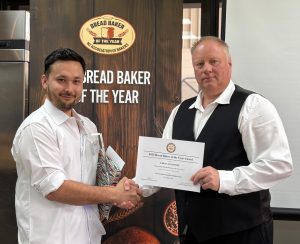
Sadat Ali Rahimi of Coupland’s Christchurch has been named NZ Association of Bakers Bread Baker of the Year. Delmari Janse van Rensburg of New World Rolleston was named second in the competition and was awarded Young Bread Baker of the Year.
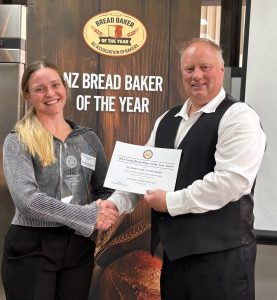
Both winners have won a grant of up to $15,000 to use for research on a bakery related subject. Delmari has also been nominated to represent New Zealand at the LA Judge Award in Australia in May 2025.

Ali has fond memories of his Grandfather’s bakery in Afghanistan and he wonders if that is why when he arrived in New Zealand in 2014 he took a role as a packer at Coupland’s Christchurch. Ali worked his way through the departments at Coupland’s and with hard work and support from the Coupland’s team he made his way to the bread plant. In 2023 he completed his New Zealand Certificate in Trade Baking (Plant Bread) Level 4. Ali enjoys working on all the different steps of the bread manufacturing process and enjoys the challenge of consistently making quality bakery products.

Delmari didn’t set out to be a baker, in fact she started a degree in Marketing but once she discovered baking, her passion for a career in the industry grew. Originally from South Africa, for the last four years, Delmari has worked in the bakery department at New World Rolleston. In July of this year, Delmari completed her New Zealand Certificate in Trade Baking Level 4. Within her role at New World, Delmari is involved in all stages of the baking process and enjoys the personal satisfaction of seeing the products she has created on the shelf.

The Competition is open to nearly or newly qualified bread bakery apprentices. This year is the first time that the competition has offered two classes of entry, a new open class with no age limit and the original Young Baker class where candidates must be no older than 30 years of age on 1 January 2024. Competitors were required to present a speciality bread and describe their product development process and how they would market their product. Entrants also completed a 90-minute theory of baking technology exam and a five-hour practical session.

Judging Co-ordinator Tania Watson says the “new concept of asking contestants to bring their own speciality breads to the competition worked well with some interesting concepts that were made well and tasted good too.”

Judge Grant Inns echoed the thoughts of the Judging Team by saying “the standard of the entrants was very high this year which is truly a credit to the amount of preparation that the contestants have completed.”

Judge Joe Jarkiewicz said, “he was pleased to see representation across all sectors of bakery industry – in store, craft and plant bakeries.” This has allowed contestants to share with their competitors the different processes they engage in within their bakeries.

Judge Nathan Roberts, a past competitor himself, was also impressed by the high standards this year and said, “that the addition of the open class to the Bread Baker of the Year Competition was a positive new dynamic.”

The Bread Baker of the Year Competition is sponsored by the New Zealand Association of Bakers and is designed to promote excellence in people emerging from their training.

ENDS ///
Follow us on Facebook: Young Bread Baker of the Year
For more information, please contact
Tania Watson – Judging Coordinator
New Zealand Association of Bakers
E: tania@bakingresearch.org.nz
M: 021 1659949

Go Green Expo

Saturday, March 30th, 2024

Food & beverages, organic products, health & wellness, beauty & personal care, home & living and many more categories are showcased at this fantastic event that is not to be missed!
Whether you’re looking for more sustainable options or wanting to become healthier – there are a large, diverse range of companies, products and brands here to help you out at the Go Green Expo.